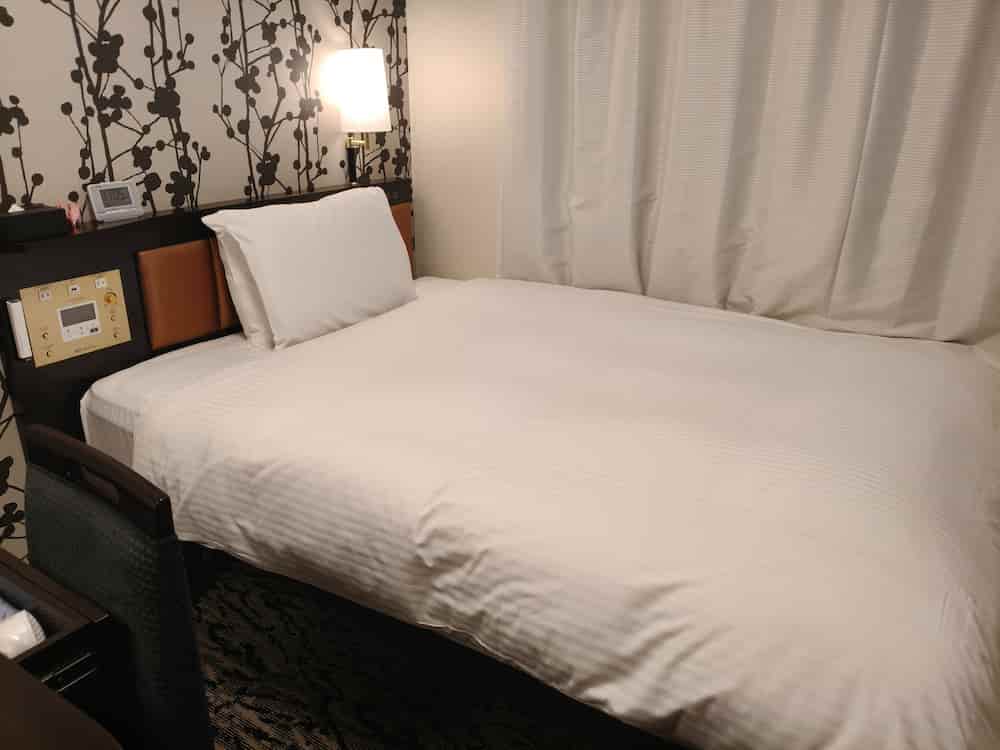
Throughout this article, we’ve explored various elements of APA Hotel’s room design—
from wall patterns and curtain direction to lighting and furniture layout.
As someone who has achieved APA’s President rank for two consecutive years,
I’ve had the opportunity to stay at many different APA properties across seasons,
and naturally, certain subtle patterns and tendencies began to stand out.
Looking back with that experience in mind,
APA’s rooms seem to offer more than just compact convenience.
They begin to appear as spaces that have been carefully considered with questions such as:
- How can a small room feel less small?
- How can comfort be created through visual balance?
- How can movement within the room feel intuitive and relaxed?
Of course, we cannot say with certainty
how much of this design was explicitly intended.
But after dozens of stays and countless observations,
certain recurring features start to form a coherent picture.
① Do Many Small Design Choices Create a Sense of Spaciousness?
As seen across Chapters 1 through 4, APA seems to layer multiple subtle choices:
- Different wallpapers on each of the four walls to reduce the “box effect”
- A mix of vertical and horizontal patterns to balance height and width
- Lighting that softens shadows and creates gentle depth
- Compact furniture that maintains clear movement paths
Individually, each element is small.
But when combined in one compact room,
they may create a perception of “more space than the floor plan suggests.”
This accumulation of micro-designs could be one reason
APA rooms often feel surprisingly comfortable.
② A Sense of Unity May Help Create “Calmness”
Even though each APA property has its own character,
many design cues seem consistent across locations:
- Repeated geometric patterns
- A shared palette of black, beige, and gold
- Horizontal curtains used almost universally
- Soft, indirect illumination
This consistency may contribute to the unique
“APA calmness” that some guests feel without explicitly noticing why.
There were moments during my stays
when I felt an unexpected sense of comfort,
and looking back, it often came from
how visually organized the room felt.
③ Comfort Comes Not Only From Facilities, but From “Perception”
APA is often recognized for its amenities—large baths, abundant toiletries, a well-designed app—but
the experience inside the guest room may rely heavily on how things are perceived, not just what physically exists.
Questions like:
- How does the space appear at first glance?
- Where does the eye naturally travel?
- How do patterns and light interact?
- What is emphasized—and what is intentionally quiet?
These elements may play a significant role in shaping
the overall sense of ease, despite the compact size.
◆ Chapter 5 Summary — A Question for You
Rather than being “just a place to sleep,”
APA rooms might be seen as carefully arranged spaces
that use design, light, and layout
to create a surprisingly comfortable experience within limited square footage.
When you stay at APA next time,
you might try looking a little closer.
Which wall draws your attention first?
Which light feels most soothing?
Which placement of furniture feels most natural to you?
Your answers may offer clues
to your own “core experience” of staying at APA.

コメント