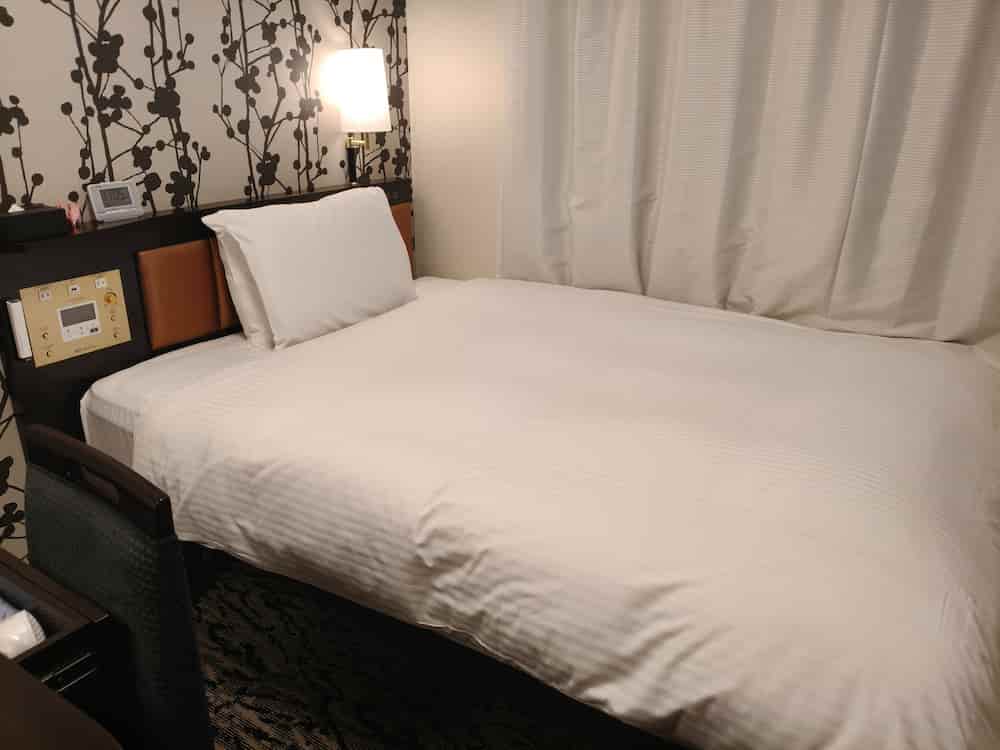
When observing APA Hotel rooms,
you may begin to notice a certain logic in how the furniture is arranged
and how the eye naturally moves within the space.
Although the furnishings are compact and minimal,
the room often feels easy to navigate and less cramped than its size might suggest.
This gives the impression that the layout decisions may be more intentional
than they first appear.
In this chapter, I’d like to look at APA’s furniture placement and
how these choices may guide movement and visual flow.
① A Layout That Minimizes “Travel Distance”?
In many APA rooms, the path from the entrance to the bed or desk
is surprisingly simple—often a straight line or a single curve.
For example:
- Entrance → Bed
- Entrance → Desk
- Entrance → Bathroom
These paths are rarely complicated.
In a compact room, this simplicity may help create
a sense of comfort and clarity:
you don’t have to “figure out” where to walk.
If you stay again,
try paying attention to how easily you can move from the door to the bed.
You may find the route is more intentional than expected.
② Desk Placement That Encourages a “Sense of Escape”?
In most APA rooms, the desk is placed near the window
or oriented horizontally along a wall.
This placement may allow:
- a horizontal view while seated
- natural “sideways” visual flow
- a feeling of openness near the desk area
If the desk were positioned in the center of the room
or directly facing the bed,
the space might feel more enclosed.
The current placement seems to help the room maintain
a sense of openness and “visual escape.”
③ Compact Furniture to Reduce Pressure and Visual Weight?
APA’s furniture is often slightly smaller than average,
or stripped down to essentials:
- foldable luggage rack
- slim desk depth
- lightweight chair
- thin-profile TV
While these may be practical choices,
they also appear to:
- free up walking space
- reduce visual heaviness
- expose more of the wall, increasing perceived room size
In this sense, the furniture seems designed
not to dominate the space,
but to blend into it.
④ Mirrors That “Double” the Perceived Space?
Many APA rooms include a full-length mirror—
often positioned near the entrance, beside the desk, or close to the bed.
Mirrors have the well-known effect of
making a room appear to extend beyond its physical boundaries.
Because they reflect:
- light
- wall patterns
- furniture lines
- ceiling height
they may create the impression of greater space
than what the floor plan suggests.
The placement of mirrors feels intentional,
as if they are tools to help broaden the visual field.
⑤ TV Placement That Helps Distribute Attention?
APA often mounts the TV slightly to the side
rather than directly in front of the bed.
This offset placement may:
- encourage the eyes to move around the room
- draw attention to different areas
- prevent a single focal point from dominating the space
A large, centered TV could confine the visual field,
making the room feel smaller.
By shifting it slightly, APA may subtly guide the viewer’s attention
across the room instead.
◆ Chapter 4 Summary — A Question for You
Seen through the lens of furniture layout and visual flow,
APA’s rooms seem to incorporate many small choices
that balance ease of movement with a sense of spaciousness.
During your next stay,
try observing how the furniture is placed
and how your eyes naturally move through the room.
Which arrangement feels most comfortable to you?
Which elements helped the room feel more open?
コメント