If you’ve stayed at APA Hotels,
you may have noticed that the lighting feels a bit different from typical business hotels.
Some guests might think:
- “The ceiling light isn’t centered.”
- “The room feels bright, but in a soft way.”
- “The wall seems to glow rather than the whole room being uniformly lit.”
These impressions may not be accidental.
Lighting can greatly influence how spacious or calm a room feels,
and APA’s lighting choices often appear intentional.
In this chapter, I’d like to explore how APA might be using light
to enhance the experience of a compact room.
① Why Are Ceiling Lights Often Not Placed in the Center?
In many homes and hotels, ceiling lights are placed in the middle of the room.
APA, however, frequently places the ceiling light closer to one side,
often near the wall.
This positioning may help
“wash the wall with light rather than illuminating the room evenly.”
When light hits a wall,
shadows soften and the room’s boundaries become less defined,
which can make the space feel a bit larger.
If you have the chance,
try paying attention to where the ceiling light is installed
and how the light falls across the walls.
② Indirect Lighting May Highlight Textures and Patterns
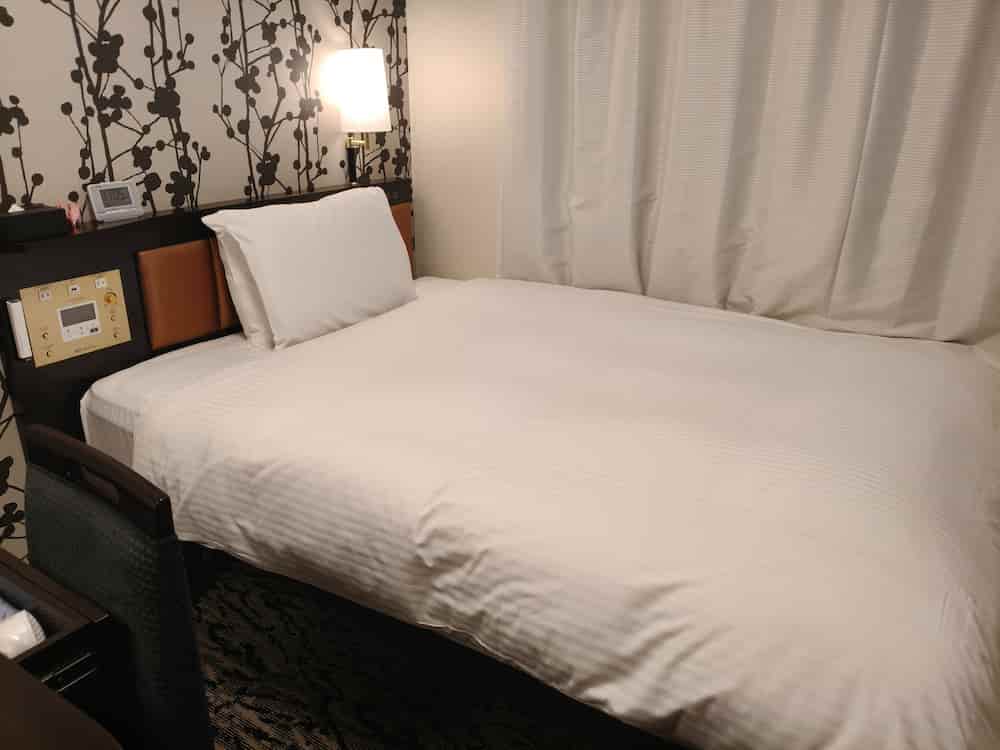
One notable feature in many APA rooms is the indirect lighting
around the headboard or geometric-patterned wall behind the bed.
When soft light hits the ridges or textures of these patterns,
they appear more three-dimensional,
adding depth and richness to the room.
This combination of light and pattern
may serve as a visual anchor that organizes the space.
③ Desk Lighting Balances “Functionality” and “Calmness”
The lighting near the desk tends to be gentle,
casting a horizontal spread rather than a strong downward spotlight.
This softer approach may help:
- keep the workspace bright enough to be useful
- avoid harsh shadows
- reduce the sense of pressure in a compact desk area
For business travelers, this balance can make the environment
more comfortable for working without feeling overwhelmed by direct light.
④ Light Through Horizontal Curtains Spreads Softly Across the Room
As discussed in Chapter 2, APA’s curtains and sheer curtains
use horizontal patterns almost consistently.
This design also influences how natural light enters the room.
Horizontal textures in sheer curtains may help
diffuse light sideways,
allowing morning sunlight to spread more evenly.
Even when the window itself is not large,
the soft horizontal spread of light can create a brighter,
more open impression.
⑤ Combining Light and Shadow May Guide the Eye Gently
APA rooms often include multiple light sources:
- stronger ceiling lights
- softer indirect lights
- desk lights
- natural light from the window
With these layers of brightness,
the viewer’s eyes move naturally around the room
instead of focusing on a single bright point.
This gentle distribution of attention
may contribute to the sense of spaciousness.
The lighting seems designed not just for illumination,
but for shaping the perception of the room as a whole.
- ① Why Are Ceiling Lights Often Not Placed in the Center?
- ② Indirect Lighting May Highlight Textures and Patterns
- ③ Desk Lighting Balances “Functionality” and “Calmness”
- ④ Light Through Horizontal Curtains Spreads Softly Across the Room
- ⑤ Combining Light and Shadow May Guide the Eye Gently
- ◆ Chapter 3 Summary — A Question for You
◆ Chapter 3 Summary — A Question for You
APA’s approach to lighting appears to play a role
beyond simply making the room bright.
By balancing direction, intensity, and softness of light,
APA may be crafting a space that feels more comfortable
than its actual size might suggest.
During your next stay,
try observing how each light source shapes the room.
Which lighting effect feels most comfortable to you?

コメント